
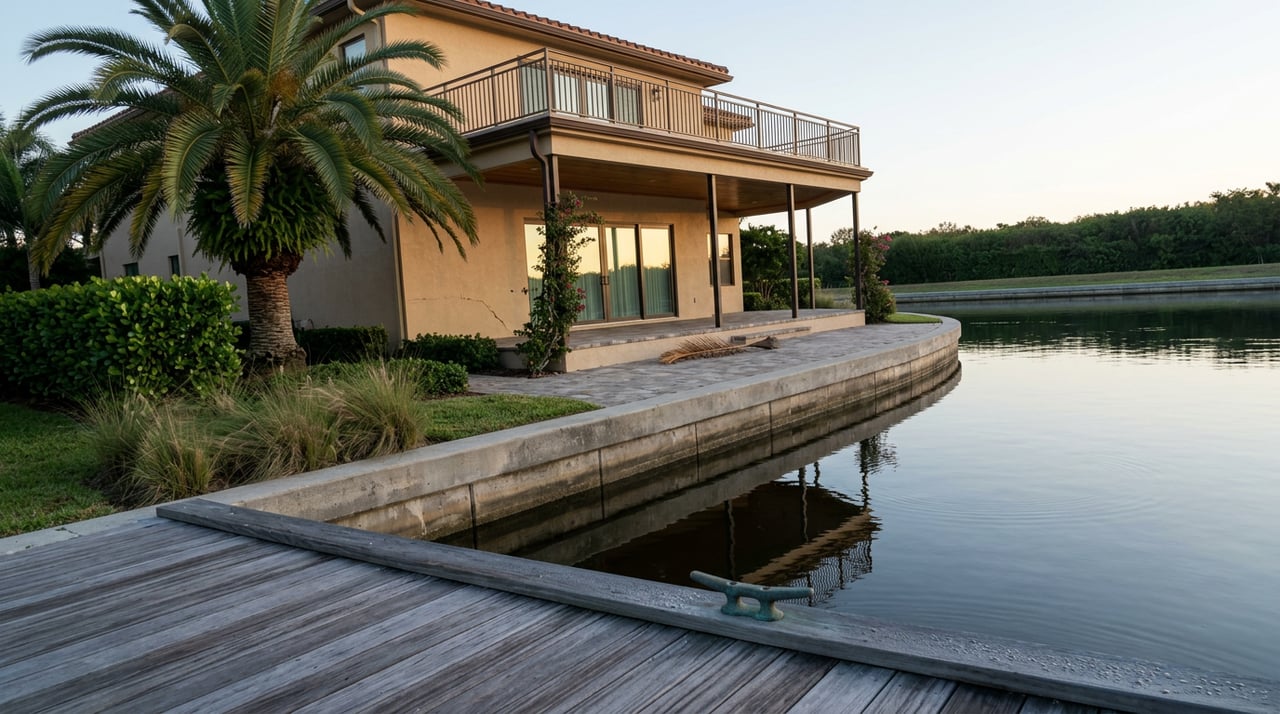
If you've lived on a canal in Royal Harbor any time since the fall of 2023, you know the drill. A notice goes up. You move your boat to a neighbor's dock or trailer it into your own driveway, because for the next stretch of days a barge with a mechanical cutterhead has the right of way in your canal, working 7 a.m. to 5 p.m., chewing through rock a few feet at a time. Then it moves on, and it's someone else's turn.
That's been the rhythm of the East Naples Bay Dredging and Rock Removal Project for three years now, and the timeline the City of Naples published identified the southern canals as the ones that would be dredged last. Here's what that actually means, and why it took this long compared to the dredging your neighbors across the bay just finished.
A Taxing District Residents Voted For Themselves
The reason this project exists at all traces back to 1987, when property owners in Golden Shores, Oyster Bay, and Royal Harbor voted to form the East Naples Bay Special Taxing District specifically to fund navigability and water quality maintenance in their own canals. The City of Naples says the district covers both sides of Curlew Avenue south through Royal Harbor, but stops at the water's edge for homes that front Naples Bay directly. If your dock sits on a canal, you're in it. If your lot faces the open bay, you're not, and you've never had to think about this project at all.
That distinction matters because it explains who's been living through the disruption and who hasn't. It also explains why this is a resident-funded fix rather than a one-off city favor. Canals silt and rock in over decades, so they need periodic maintenance to stay navigable.
Why This Dragged On Longer Than Port Royal's
Here's the part that surprises people who assumed all Naples canal dredging looks the same. Port Royal finished its own canal project years ago. That work, across Champney Bay, Doubloon Bay, Galleon Cove, and Harbour Head, dealt mostly with accretion, the slow buildup of sand and silt that narrows a channel over time. It's straightforward removal, and the city's special assessment page for that project now simply lists it as complete, with assessments being paid off.
Royal Harbor's canals had a different problem. The material crews are pulling out is primarily rock, not sand, roughly 3,000 cubic yards of it against about 1,000 cubic yards of sediment. Rock doesn't come out with a standard dredge. It has to be cut, which is why the contractor, Quality Enterprises, is running a mechanical cutterhead attachment on an excavator instead of a conventional suction dredge. That equipment choice was also meant to cut down on the noise and vibration hitting nearby homes, which is why you may have noticed vibration monitors quietly staked in backyards along the canal during active work. Rock removal is simply a slower, heavier job than scooping sand, and that difference in material is the real reason Royal Harbor's project outlasted its counterpart across the bay.
Add in Hurricane Ian, which dumped fresh debris into canals that had already been surveyed and forced the county's contractor to re-survey everything before restarting work on September 25, 2023. The storm alone is estimated to have added close to a million dollars to the project's cost, an expense the East Naples Bay Board asked FEMA to help cover.
The Crews' Route Through Royal Harbor
The contractor's approach has been methodical: start in the northern canals near Naples Bay Resort, then move south, working one canal at a time from the far end back toward the bay. That sequencing is worth knowing because it tells you where things stand without needing a canal-by-canal report. The project's own materials noted that once work reached the southern part of Royal Harbor, the contractor would need to rent a new staging area there, a detail that signals the southern canals were always going to be the last leg of the job.
The city's published target was substantial completion by mid-2026. For residents in the southern canals, that target marked the planned end of a disruption that began three years earlier several streets north.
A few mechanics worth remembering if your canal's turn hasn't come yet, or just did:
Boats on lifts generally don't need to move unless the city tells you otherwise. Boats without a lift do need to relocate, either to a trailer in your own driveway (Code Enforcement has allowed this temporarily), to another body of water, or to a neighboring canal that isn't actively being worked, with the option to move back once your section is finished.
What Opened While the Barges Were Working
Here's the part of this story that a lot of outside coverage misses entirely. While the canals were tied up in a multi-year construction zone, Royal Harbor's small food scene didn't pause. It expanded.
Three60 Market, tucked off Sandpiper Street at 2891 Bayview Drive, has been the neighborhood's all-day anchor for years, an espresso bar, bakery, deli, and marketplace in one storefront, known for cinnamon rolls the size of your hand and a rotating salad and sandwich menu. This year it opened a sibling a few blocks away: Three60 Wine on the Water at 833 River Point Drive, a wine bar and small-plates spot with river views that gives the neighborhood an evening option that didn't exist before.
The rest of the map filled in around it:
- Taqueria San Julian, a no-frills strip-plaza spot on Bayshore Drive near the entrance to Royal Harbor, serving tacos al pastor, lengua, and carnitas with homemade salsas
- Glazed Donuts at the corner of Davis Boulevard and Sandpiper Street, hand-rolled yeast donuts and strong coffee just outside the neighborhood line
- Royal Scoop Homemade Ice Cream on Thomasson Drive, small-batch flavors like Toasted Coconut and Kahlúa Crunch that have been a Naples favorite for years
- Brookside Bites, a rotating food truck rally at Brookside Drive and Davis Boulevard on select weekends, with barbecue, farm-to-table, and gourmet burger trucks that show up according to local social media rather than a fixed schedule
None of this required the canals to be finished. It happened in parallel, which says something about how the neighborhood's business owners read the disruption: as temporary, not existential.
The Country Club Next Door
A lot of Royal Harbor residents treat Naples Bay Resort as their unofficial club, even without a membership card. The resort's marina sits right at the mouth of the canal system, and its restaurant lineup, NOSH on Naples Bay for globally inspired small plates, Blackbird for Asian-Gulf fusion, Cafe on the Bay for espresso and pastries, and BlueWater Bar and Grill for a poolside lunch, gives residents a walkable or boatable dinner option without leaving the immediate area. For a neighborhood built around docks rather than sidewalks, having a full-service marina restaurant row a few minutes by water is part of what makes the daily rhythm work.
What Actually Changes This Fall
Put the two threads together and the picture is simple. Royal Harbor spent three years absorbing a slow, rock-by-rock dredging project that ran longer than a comparable job in Port Royal because the material underneath the water was harder to move. The southern stretch was identified as the project's final leg. At the same time, the neighborhood quietly built out a second food and drink option, a wine bar, that didn't exist when the barges first showed up.
For someone who lives here, that means two things are arriving close together this year: full canal depth back at your dock, without the driveway boat and the 7 a.m. equipment noise, and an actual two-stop evening loop between Three60 Market's original café and its new wine bar down the street. Neither one depended on the other, but this fall is the first time in three years both are true at once.
If you want more of this kind of ground-level read on what's actually changing in Naples neighborhoods, not the generic version every site runs, Live in SWFL tracks it block by block. Reach out any time you want the real story on what's happening where you live.
This article is general information, not legal, tax or financial advice. Consult a qualified professional about your situation.