
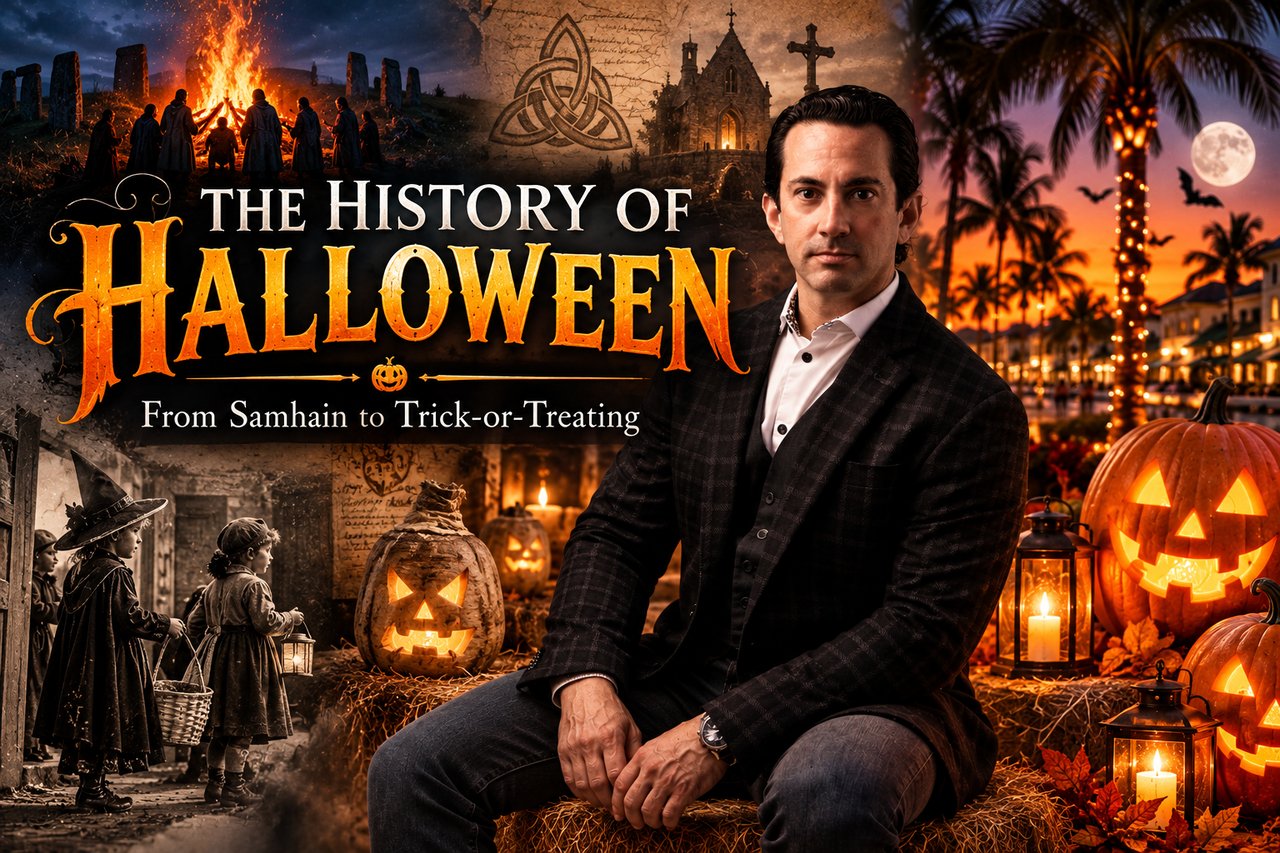
How an ancient festival marking the end of summer evolved into costumes, jack-o’-lanterns, trick-or-treating and one of America's favorite nights of the year
Every October, something strange happens.
We carve faces into perfectly good pumpkins. We decorate our homes with skeletons. Adults willingly pay money to have strangers jump out and scare them. Children dress as everything from witches to superheroes and walk door-to-door demanding candy from the neighbors.
And somehow, we all collectively agree that this is completely normal.
But Halloween didn't begin with plastic skeletons, fun-size candy bars or elaborate neighborhood decorations. Its story stretches back roughly 2,000 years, crossing ancient Celtic traditions, medieval Christianity, Irish and Scottish folklore and eventually the Atlantic Ocean before evolving into the Halloween Americans celebrate today. Research Guides
So, before we decide who gets the Reese's and who gets stuck with the candy corn, let's travel backward through the fog.
🔥 It Begins With Samhain
One of Halloween's most important ancestors was the ancient Celtic festival of Samhain, pronounced roughly "sow-in."
Samhain, meaning "summer's end," marked a seasonal turning point around November 1. The harvest was ending and the darker, colder portion of the year was beginning. Celtic traditions held that this transition was also a time when the boundary separating the living from the supernatural world became unusually permeable. Smithsonian Magazine
That helps explain some traditions that sound remarkably familiar today.
People lit fires, left offerings of food and sometimes disguised themselves. According to historical accounts summarized by Smithsonian, disguises could help people avoid or confuse supernatural visitors roaming during Samhain. Smithsonian Magazine
Suddenly that $79 vampire costume doesn't seem quite so random.
✝️ From Samhain to All Hallows' Eve
As Christianity spread through Europe, older seasonal customs and Christian observances increasingly overlapped.
November 1 became associated with All Saints' Day, also called All Hallows' Day, while November 2 became associated with All Souls' Day.
And the evening before All Hallows?
All Hallows' Eve.
Say it enough times over several centuries and eventually you arrive at:
Halloween. Library of Congress Blogs
Rather than Halloween having one clean birthday, historians generally describe it as the product of traditions that blended and changed over a very long period. The Library of Congress describes its history as rooted in both Christian and pre-Christian Celtic customs. Library of Congress
🍰 Before Candy Bars, There Were Soul Cakes
Now we're getting closer to trick-or-treating.
During the medieval period, a tradition known as souling developed in parts of Europe. Poorer people, and eventually children, would visit homes and receive small cakes or food in exchange for prayers for deceased family members.
These became known as soul cakes. Smithsonian Magazine
In Scotland and Ireland another custom called guising emerged. Children would disguise themselves and go from house to house, sometimes performing a song, poem or other small entertainment in exchange for food or treats. Smithsonian Magazine
Costume?
Check.
Knocking on doors?
Check.
Treats?
Check.
The basic ingredients were already sitting on the kitchen counter.
🎭 Why Do We Dress Up?
Those costumes have surprisingly ancient relatives.
During Samhain, disguises were connected with beliefs surrounding spirits and supernatural beings. Centuries later, Irish and Scottish guising kept the practice of dressing up alive, although its meaning evolved. Smithsonian Magazine
By the time Halloween became firmly established in America, costumes gradually moved away from purely ghosts, witches and monsters.
Today?
Your front porch might be visited by Dracula, Barbie, Batman, a dinosaur, three princesses and a six-year-old dressed as an inflatable chicken.
Halloween has apparently become very accepting about its casting choices.
🎃 And About Those Jack-o'-Lanterns...
Here's one of my favorite pieces of Halloween trivia:
The original jack-o'-lantern wasn't necessarily a pumpkin.
Pumpkins are native to the Americas. In Ireland and Britain, people carved vegetables including turnips, sometimes creating grotesque faces associated with folklore and supernatural beliefs. Smithsonian Magazine
When immigrants brought these traditions to America, they encountered something considerably easier to hollow out:
Pumpkins.
And somewhere, generations of turnips breathed a collective sigh of relief.
🇮🇪 Halloween Crosses the Atlantic
Halloween's transformation into an American tradition accelerated with immigration, particularly from Ireland and Scotland.
Large numbers of Irish immigrants came to the United States during the 19th century. The Library of Congress notes that as many as 4.5 million Irish immigrants arrived in America between 1820 and 1930, with the devastating potato famine accelerating migration beginning in the 1840s. Library of Congress
Immigrants brought folklore and Halloween customs with them.
But American Halloween wasn't immediately the candy-filled children's holiday we know today.
For a while, it got rather rowdy.
😈 When Halloween Was More Trick Than Treat
By the late 19th and early 20th centuries, Halloween pranks could range from relatively harmless practical jokes to outright vandalism.
Windows were soaped. Gates disappeared. Objects mysteriously found their way onto rooftops. As America became increasingly urbanized, Halloween antics sometimes became destructive enough that communities actively looked for ways to tame the holiday. Smithsonian Magazine
The solution?
Give the little monsters something better to do.
Community celebrations increasingly focused on children, costumes, parties and treats.
The bargain became wonderfully simple:
We'll give you candy. You leave the mailbox alone.
Civilization had prevailed.
Mostly.
🍬 When Did "Trick or Treat" Begin?
The familiar phrase is much younger than Halloween itself.
Research cited by Smithsonian traces printed versions of "trick or treat" to the 1920s, with early examples appearing in Canadian newspapers. The practice spread more widely through North America during the following decades. Smithsonian Magazine
After World War II, several things came together perfectly.
Sugar rationing ended. American suburbs expanded. Families lived in neighborhoods where children could easily walk from house to house. Individually wrapped candy also offered an extremely convenient treat for homeowners to distribute. Smithsonian Magazine
By the 1950s and 1960s, trick-or-treating was becoming inseparable from American Halloween.
Interestingly, candy wasn't always the automatic reward. Children once received cookies, cake, nuts, money, toys and other treats. Halloween's intense association with commercially packaged candy developed primarily during the mid-20th century. Smithsonian Magazine
Imagine opening your Halloween bag today and finding a handful of walnuts.
There would be riots.
👻 Halloween Keeps Reinventing Itself
That's probably my favorite thing about Halloween's history.
It never really stopped changing.
An ancient festival marking the transition into winter absorbed religious traditions. Customs surrounding spirits evolved into disguises and games. Medieval souling and Scottish and Irish guising helped provide ingredients for trick-or-treating. Immigration carried traditions across the Atlantic. American communities turned unruly pranks into children's festivities. And businesses eventually discovered that people are remarkably willing to purchase enormous quantities of miniature chocolate bars once a year.
Yet pieces of the old traditions are still hiding in plain sight.
Bonfires became candles.
Disguises became costumes.
Offerings became treats.
Turnips became pumpkins.
Guising helped evolve into trick-or-treating.
And the ancient fascination with the boundary between the living and the dead?
We still spend every October filling our yards with ghosts.
🌴 From Ancient Celtic Fires to Halloween Under the Palms
Which brings us all the way back to Southwest Florida.
Halloween certainly looks different here.
Instead of cold autumn nights, we may be carving pumpkins in shorts. Our haunted houses sit beneath palm trees. Trick-or-treating can happen while it's still 80 degrees outside, and the closest thing we have to falling autumn leaves may be palm fronds after a windy afternoon.
But perhaps that's perfectly appropriate.
Halloween has survived for centuries precisely because every generation and every place has made it a little bit its own.
And now, here in Naples and Bonita Springs, we're doing exactly the same thing.
So when you're wandering through a haunted corn maze, carving a jack-o'-lantern, handing candy to costumed children or heading out to one of the Halloween events around Southwest Florida this October, remember:
You're participating in the latest chapter of a story that began thousands of years ago.
Although personally, I'm grateful we've replaced the carved turnips with pumpkins.
Some traditions really do improve with age. 🎃
Thinking about buying or selling in Naples?
Protect your investment with a trusted local expert by your side.
📞 Call Brian J Giacomello at 239-281-5269
📧 Email: [email protected]
William Raveis Real Estate | 720 5th Ave S. #201 Naples FL 34102