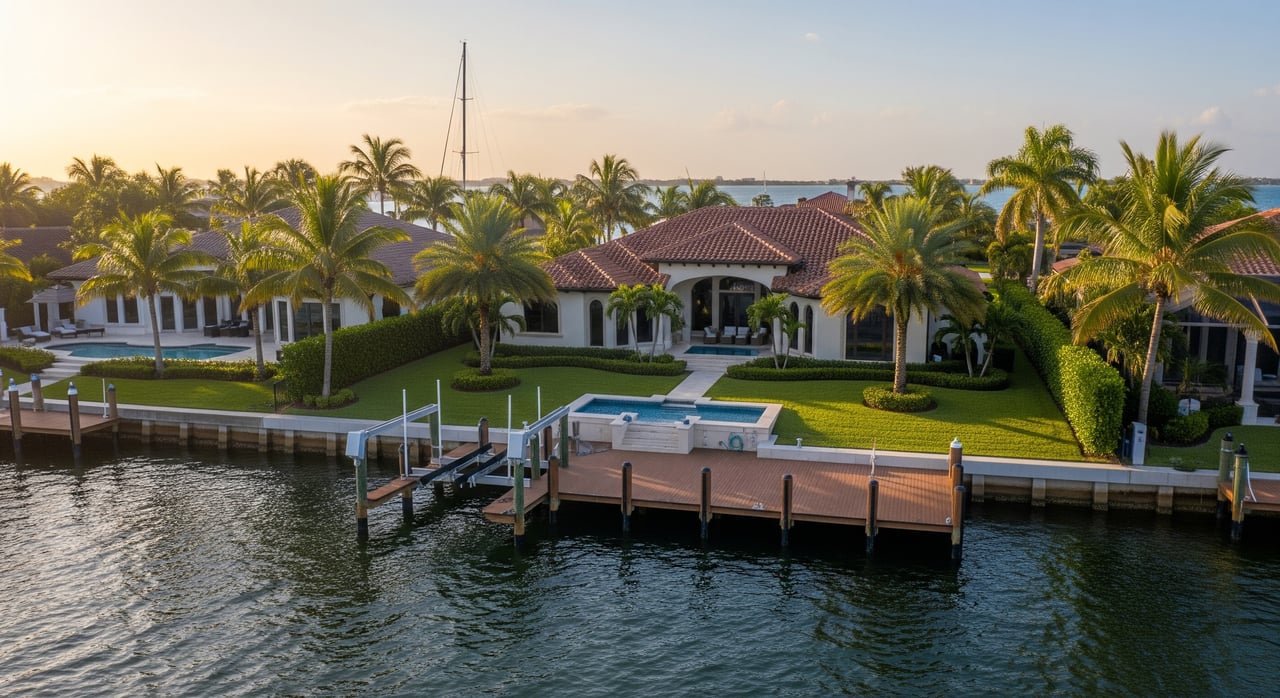
Are two Aqualane Shores waterfront lots ever truly the same? Stand on the seawall at 3 p.m., feel the sun on your shoulders, and picture easing a 35-foot boat into a slip with a crosswind. Small differences in sun, canal width, and dock layout change your day-to-day experience more than most listings reveal.
If you want bright pool days, privacy on your terrace, and low-stress docking, a little planning goes a long way. In this guide, you’ll learn how lot orientation, canal geometry, and dock design work together in Aqualane Shores, plus simple checklists and diagrams you can use during property tours. Let’s dive in.
Sun, views, and orientation in Aqualane Shores
Naples sits near 26 degrees north latitude. The sun rises roughly in the east, sets in the west, and tracks to the south at mid-day most of the year. That matters for pools, outdoor kitchens, and interior light.
- South-facing waterfront: The deck and pool receive the most direct sun throughout the day. Expect warm, bright outdoor living and sun-filled interiors.
- East-facing waterfront: You’ll enjoy strong morning light and cooler afternoons, which can be welcome in summer.
- West-facing waterfront: Late-day sun delivers dramatic sunsets and more afternoon heat on terraces and inside main living areas.
- North-facing waterfront: Receives the least direct sun, so outdoor spaces run cooler and shadier.
Open water views toward Naples Bay often trend south or southwest. Lots that open to the bay typically offer broader sightlines and fewer direct neighbor-to-neighbor views. Corner and end lots may see more boat traffic and cross-canal sightlines, which can feel less private.
Quick on-site checklist: Sun and sightlines
- Walk the outdoor areas morning, mid-day, and late afternoon. Note where the sun hits the pool, terrace, and main living spaces.
- Look down the canal. Are neighbor docks offset or directly across from your deck and windows?
- Scan nearby homes and landscaping. Taller structures or palms can cast afternoon shade on your waterfront area.
Visual guide: Orientation and sun
East-facing water (morning light)
  AM sun ➜
  [Street/house]
  [Living area]
  [Deck]
  SW ──────D────── (water)
  Canal → (view east)

South-facing water (most sun)
  [Street/house]
  [Living area]
  [Deck]
  SW ──────D────── (water south)

West-facing water (sunset view)
  [Street/house]
  [Living area]
  [Deck]
  SW ──────D────── (water)
  ◀── PM sun
Canal width, depth, and dock layout
Aqualane Shores is prized for private docks and quick access to open water, but not all canals handle vessels the same way. Width, depth at mean low water, winds, and currents shape how easy it is to maneuver and what dock you can build.
- Canal width: Wider canals allow more comfortable turns, multi-slip layouts, and center docks with finger piers. Narrow canals may limit you to side-tie or parallel lifts.
- Water depth at mean low water: Depth dictates draft limits, whether a lift is needed, and where a T-dock or longer pier makes sense.
- Tides, currents, and fetch: Longer stretches of open water can generate chop. Crosswinds and current make docking more demanding on tight canals.
- Location to the main channel: Shorter runs to open water simplify daily boating. Longer, winding canals increase complexity.
As a conservative starting point, allow roughly 2 to 3 times your boat length in unobstructed canal width for comfortable turning. For a 30 to 40 foot boat, canals under about 60 to 90 feet wide can noticeably restrict pivoting and may require backing or assistance.
Narrow vs. wide canals: What changes for you
- Narrow canals: Expect careful approach angles, parallel lifts along the seawall, and limited turning room. Privacy can be good, but larger boats face more stress in wind or current.
- Moderate canals: Turning is feasible with planning. Center docks with one or two finger piers often work if permits allow.
- Wide canals: Multi-slip configurations, easier 180-degree turns, and more flexible dock design.
Visual guide: Turning room
Narrow canal:
  |W|
  -----B (difficult 180° turn, may need backing)

Moderate canal (~2–3× boat length):
  |W W W|  (enough room for pivoting and repositioning)

Wide canal:
  |W W W W W| (comfortable turning, multi-slip docks feasible)
Dock types and trade-offs
Parallel or side-tie along seawall
- Pros: Minimal canal intrusion, simple for smaller boats, often better privacy.
- Cons: Less convenient for stern-in launching with larger vessels and fewer slip options.
Center dock with finger piers
- Pros: Multiple slips, easy water access, good social and gathering space.
- Cons: Uses more canal width, increases visual exposure to neighbors, can face permit limits.
T-dock or longer pier to deeper water
- Pros: Access to deeper water for larger boats, keeps near-shore area clearer.
- Cons: More exposure to wind and waves, longer walk, higher cost and permitting complexity.
Boat lifts vs. floating docks
- Lifts: Reduce draft needs and protect hulls, but add height and visual bulk and require power.
- Floating docks: Follow the tide and can be comfortable to use, although maintenance increases in exposed locations.
Maneuverability checklist for tours
- Measure or confirm canal width at the lot and at any nearby turning basin.
- Verify depth at mean low water for your vessel’s draft and propeller depth.
- Identify submerged hazards, shoaling, or sandbars reported locally or charted.
- Note neighboring docks, piles, and peak traffic times that affect approach and turning.
Privacy, views, and neighbor impacts
Dock placement shapes how private your terrace feels and how your neighbors experience theirs. Centered docks with wide finger piers create open sightlines down the canal, which can reduce privacy. Side-tie layouts closer to one property line may shift sightlines away from your primary outdoor area, but they can redirect views toward adjacent yards.
Elevated docks and tall lifts add visual bulk and can create second-story sightlines. End or corner lots may enjoy bigger views while seeing more through-traffic and boat activity.
Mitigation strategies to consider
- Orient slips and lifts so engines and activity face away from your main outdoor living areas.
- Use thoughtful landscaping, hedges, and screens to block lateral views while maintaining your view corridor.
- Choose downlighting or shielded fixtures that reduce glare toward neighbors and the water.
Privacy checklist during a showing
- Stand on the deck and inside key rooms. Note the angles from neighbor docks and walkways into your spaces.
- View the home from the water if possible, or from across the canal, to gauge visibility from passing boats.
- Ask about neighborhood rules or municipal limits on dock size, lighting, and placement.
Visual guide: Dock placement options
Option 1 — center dock with finger piers
  P |--SW--| P
      |
      D (center)
     / \
    /   \
   N     N
  Canal (wide) → turning room

Option 2 — side-tie / parallel to seawall
  P |--SW--| P
  D======== (parallel along seawall)
  [Deck behind dock]
  N    N
  Canal (narrow)

Option 3 — T-dock or long pier
  P |--SW--| P
      |
      | (pier)
      |
      D— (slip at end)
  Canal → open water / deeper channel
Permits, rights, insurance, and constraints
Before you plan a new dock or modify an existing one, confirm the path for approvals and any limits on design.
Permits and approvals
- Collier County building and shoreline permits set local standards and setbacks for docks and seawalls.
- Florida state authorization may be required for the use of sovereign submerged lands and to protect coastal resources.
- U.S. Army Corps of Engineers permits apply when work affects navigable waters or wetlands.
Easements and riparian rights
- Verify that your lot carries riparian rights for dock construction and note any easements along the seawall or canal that limit placement.
Seawall and bulkhead
- Owners are typically responsible for seawall condition. Seawall health affects dock stability, insurance, and long-term costs.
Insurance and risk
- Check FEMA flood zones and Base Flood Elevation for insurance implications and required structure elevations.
- Boat insurance may consider exposure to wind, wave action, and dock construction.
- Understand liability for docks and any required safety features per local codes.
Due diligence to complete early
- Request existing dock permits, surveys, and as-built drawings.
- Order a title search to identify easements that affect the waterfront.
- Engage a licensed marine contractor for a seawall and bottom inspection, plus depth confirmation at mean low water.
- Confirm setbacks and design standards with Collier County before planning changes.
- Consult NOAA charts and local marina operators about navigation hazards and typical depths.
Tour-day worksheet for Aqualane Shores buyers
Use this to stay focused during showings:
- Sun and view priorities
- Note direct sun on pool and patio morning and late afternoon.
- Decide how important sunsets are versus cooler late-day interiors.
- Canal geometry and maneuvering
- Measure or estimate canal width at the property and nearest turning basin.
- Ask about typical draft and channel depth at mean low water for your intended boat.
- Observe whether neighbor docks or pilings complicate your turn.
- Dock condition and constraints
- Inspect pilings, lifts, electrical and water service, and bulkhead tie-ins.
- Request copies of permits and any recorded restrictions.
- Privacy and sightlines
- Check visibility from neighbor docks and passing boats into main indoor and outdoor spaces.
- Look toward the nearest active channel to gauge activity and noise.
- Regulatory and insurance implications
- Confirm FEMA flood zone and likely insurance requirements.
- Ask what changes would trigger county, state, or federal approvals.
- Maintenance and long-term costs
- Note age and condition of seawall and dock components.
- Ask about lift maintenance, piling condition, and any neighborhood rules or fees related to docks or water use.
Bringing it all together
In Aqualane Shores, great waterfront living is about more than a compass view or a pretty canal. The right orientation gives you the sun you want on your deck and in your rooms. The right canal width and depth make boating low-stress. The right dock layout protects privacy without sacrificing access. When you balance these elements with clear due diligence, you position yourself for years of easy, enjoyable waterfront days.
If you want a second set of eyes on orientation trade-offs, canal geometry, or dock feasibility during your search, reach out to Brian J Giacomello, LLC for local guidance tailored to your goals.
FAQs
What lot orientation is best for pool sun in Aqualane Shores?
- South-facing waterfront gets the most direct sun for much of the day, while east-facing offers cooler afternoons and west-facing delivers stronger late-day sun and sunsets.
How wide should a canal be for a 35 to 40 foot boat?
- As a conservative rule of thumb, aim for 2 to 3 times your boat length in unobstructed canal width for comfortable turning and repositioning.
Which dock layout offers the most privacy on narrow canals?
- Side-tie or parallel docks along the seawall typically intrude less into the canal and reduce cross-canal sightlines compared to center docks with finger piers.
How does dock placement affect neighbor relations and views?
- Centered docks can open sightlines and activity toward neighbors, while offset docks and careful lighting, landscaping, and lift placement can reduce glare, noise, and visibility.
What approvals are usually needed before building or modifying a dock?
- Expect to coordinate with Collier County for building and shoreline permits, Florida state authorities for submerged lands, and the U.S. Army Corps of Engineers when navigable waters are affected.